A beautiful artificial tree can transform an empty corner, soften a room filled with hard furniture, or bring a little greenery into a space where a living tree wouldn’t thrive.
But shopping online comes with one challenge: you can’t walk around the tree, touch its leaves, or see how it looks from different angles.
And two artificial trees with the same height can look completely different once they’re in your home.
So how do you choose one you’ll actually love?
The secret isn’t finding the fullest tree or the most impressive product photo. It’s knowing which details matter for your space, your style, and your expectations.
Here are seven things we recommend checking before you buy.
1. Choose the Silhouette Before You Choose the Height
Most shoppers begin with a simple question: Should I buy a 5-foot or 6-foot tree?
But height alone doesn’t tell you how a tree will feel in a room.
Imagine two 6-foot artificial trees. One has a slim, upright canopy. The other has broad, spreading branches. They may be the same height, but they won’t take up the same visual or physical space.
Our recommendation: Start with the shape of the tree, then narrow down the height.
Consider these common styles:
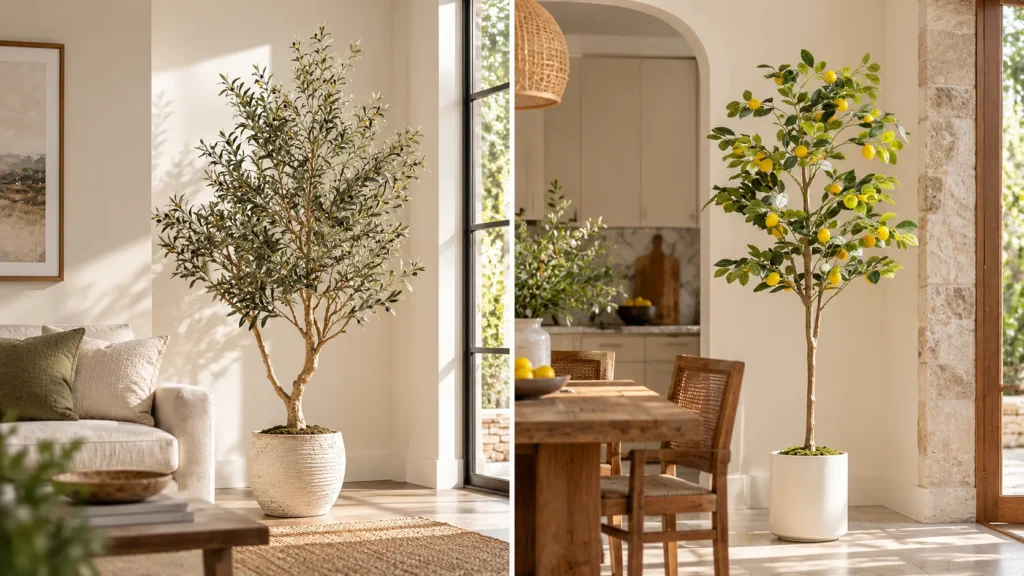
Artificial olive trees — relaxed and naturally airy
Best for: Mediterranean-inspired rooms, organic-modern interiors, and spaces that benefit from an irregular, natural silhouette.
Olive trees often look more convincing when their branches have some breathing room. Don’t assume a dense, perfectly rounded canopy is automatically more realistic.
Artificial eucalyptus trees — soft and understated
Best for: Calm, minimalist interiors and narrower spaces where you want greenery without a visually heavy canopy.
Look for gentle leaf color variation and a silhouette that feels balanced without being overly symmetrical.
Artificial lemon trees — decorative and colorful
Best for: Bright kitchens, sunrooms used as indoor living spaces, and cheerful Mediterranean-inspired interiors.
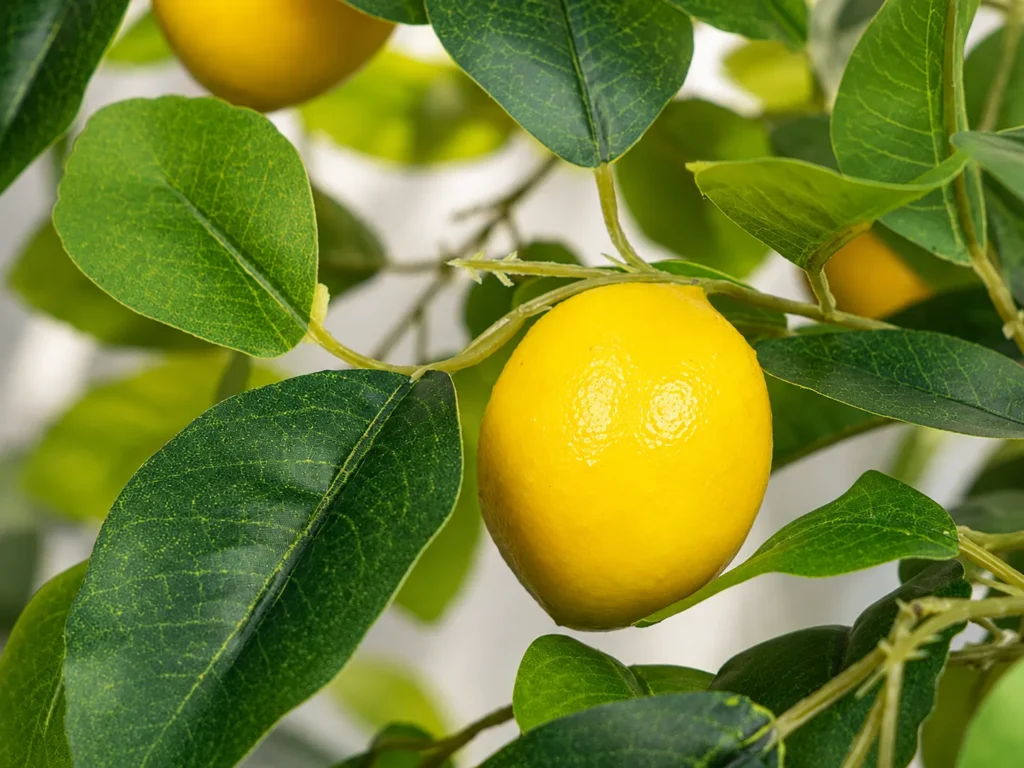
Pay attention to the number, size, and placement of the lemons. Fruit should feel integrated into the tree rather than overwhelming the foliage.
Artificial cedar trees — structured and architectural
Best for: Entryways, symmetrical indoor arrangements, and seasonal decorating.
A tapered shape can create a more formal appearance than the relaxed branching of an olive tree.
The takeaway: Choose a tree shape that complements your room before deciding whether you need another foot of height.
2. Don’t Judge Fullness by the Main Product Photo
Here’s one of the easiest mistakes to make when shopping for artificial trees: assuming that fuller always means better.
It doesn’t.
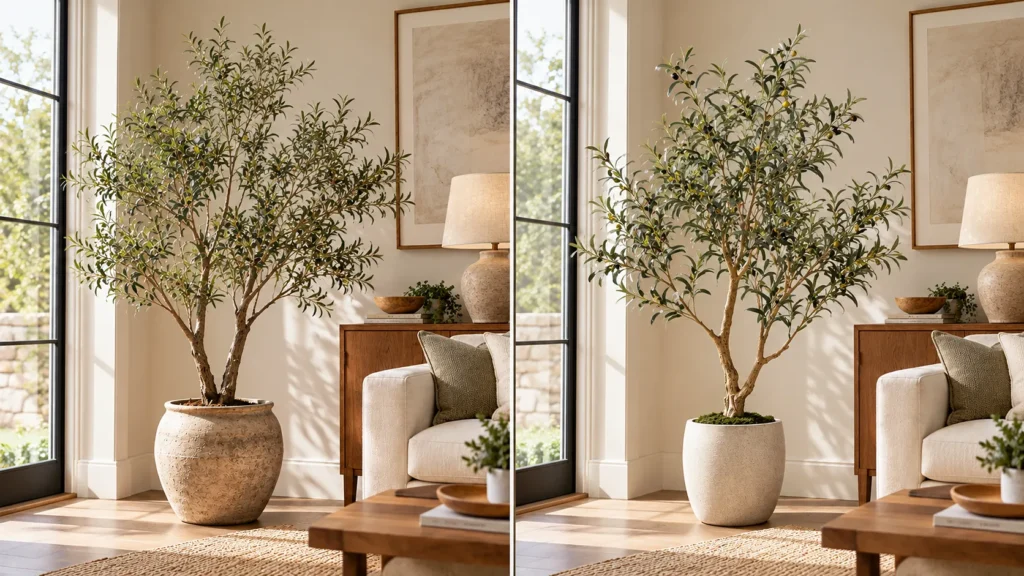
Some artificial trees are intentionally airy. Others are designed with denser foliage. What matters is whether the finished tree matches the look you’re expecting.
A well-designed olive tree may have visible spaces between its branches. That can be part of its natural character, not necessarily a flaw.
However, there’s an important difference between an intentionally open canopy and a tree that looks sparse because its foliage is unevenly distributed.
Our recommendation: Look for a full-tree photograph taken straight on, plus at least one side view.
Ask yourself:
- Does the tree look balanced from more than one angle?
- Are the gaps between branches consistent with the species?
- Does the canopy have a believable overall outline?
- Can you see the trunk and branch structure clearly?
If a listing only shows one carefully styled angle, look for additional images or customer photos before making your decision.
A useful rule: Buy the silhouette you see—not the silhouette you hope you’ll be able to create later.
3. Measure the Space, Not Just the Ceiling
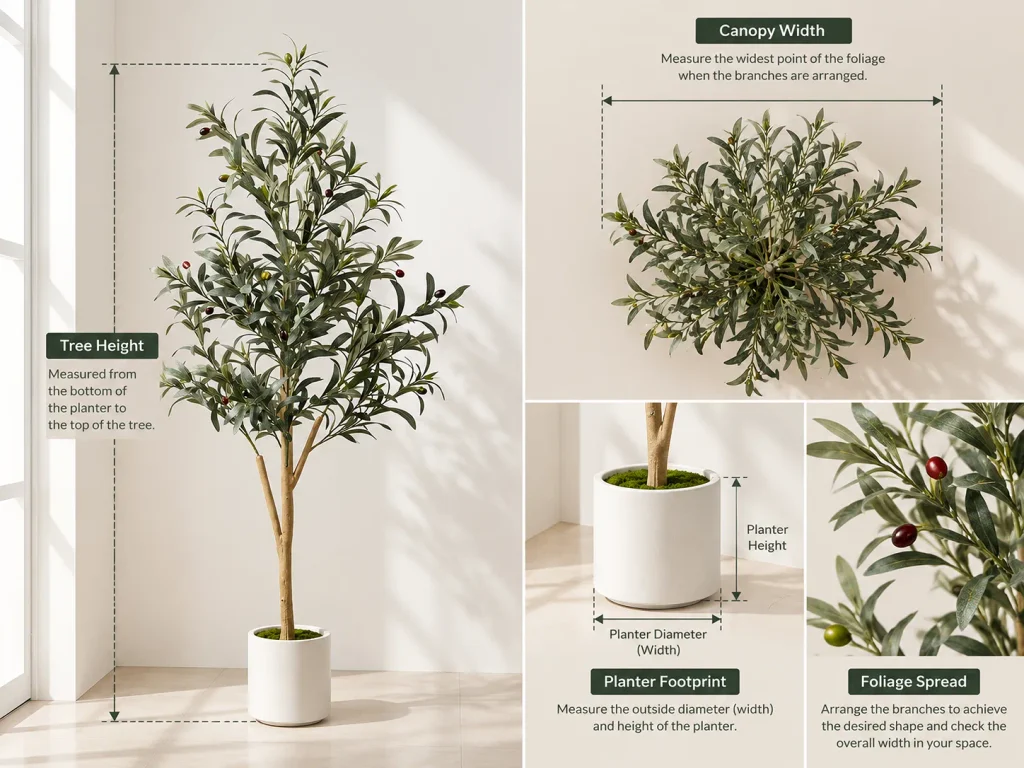
A 6-foot tree may fit beneath your ceiling and still be too large for the spot you have in mind.
The real question is how much space the tree occupies once its branches are arranged.
Before ordering, measure:
Available height: Leave enough room above the tree so the top doesn’t feel crowded.
Available width: Measure the space between nearby furniture, walls, and walkways.
Base footprint: Check whether the included planter will fit where you intend to place it.
Then compare those measurements with the product’s specifications.
For example, a narrow eucalyptus tree may work beside a bookshelf where a wider multi-trunk olive tree would feel crowded.
And if you’re considering a decorative planter, remember that it may add height and width to the overall arrangement.
Our recommendation: Use painter’s tape to mark the tree’s approximate width on the floor before buying.
It’s a simple way to see whether the tree will interfere with a doorway, chair, or walking path.
If the canopy width isn’t listed, ask the seller. Don’t estimate it solely from furniture shown in lifestyle photos.If you’re still deciding where your tree should go, our Where to Place an Artificial Tree in Your Home guide offers practical ideas for balancing greenery with furniture, walkways, and available floor space.
4. Watch the Assembly Video Before You Buy
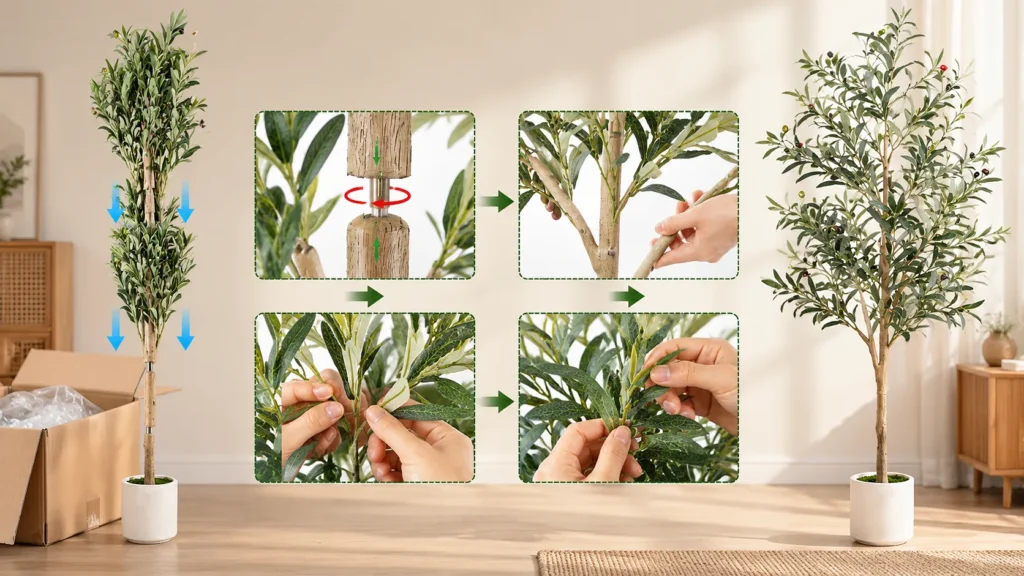
A finished product photo tells you what a tree can look like. A real assembly video shows you what it takes to get there.
This is especially helpful when buying a larger artificial tree or a model with multiple trunk or branch sections.
A video can answer questions that photographs often can’t:
- How many components need to be connected?
- How are the sections assembled?
- How much branch shaping is involved?
- Does the tree look noticeably different before and after shaping?
- Are the steps easy to follow?
Our recommendation: Watch the actual model being assembled whenever a product-specific video is available.
Don’t assume that every size or tree type uses the same assembly method.
See How Adorbox Artificial Trees Are Assembled
Watch real setup demonstrations for our artificial olive, eucalyptus, lemon, and cedar trees.
Assembly methods may vary by tree type, size, and model. Always follow the instructions supplied with your specific tree.
One important distinction: assembly and shaping aren’t the same thing.
Assembly means putting the required components together. Shaping means adjusting the branches and foliage to create the intended silhouette.
A tree may be straightforward to assemble but still require some patience to arrange naturally.
And while shaping can improve the position of existing branches, it cannot add missing foliage or correct damaged structural components.
5. Look Closely at the Leaves and Branch Connections
The details that make an artificial tree convincing aren’t always obvious in a full-room photograph.
A tree may look attractive from across the room but less natural when viewed up close.
That’s why detail photos matter.
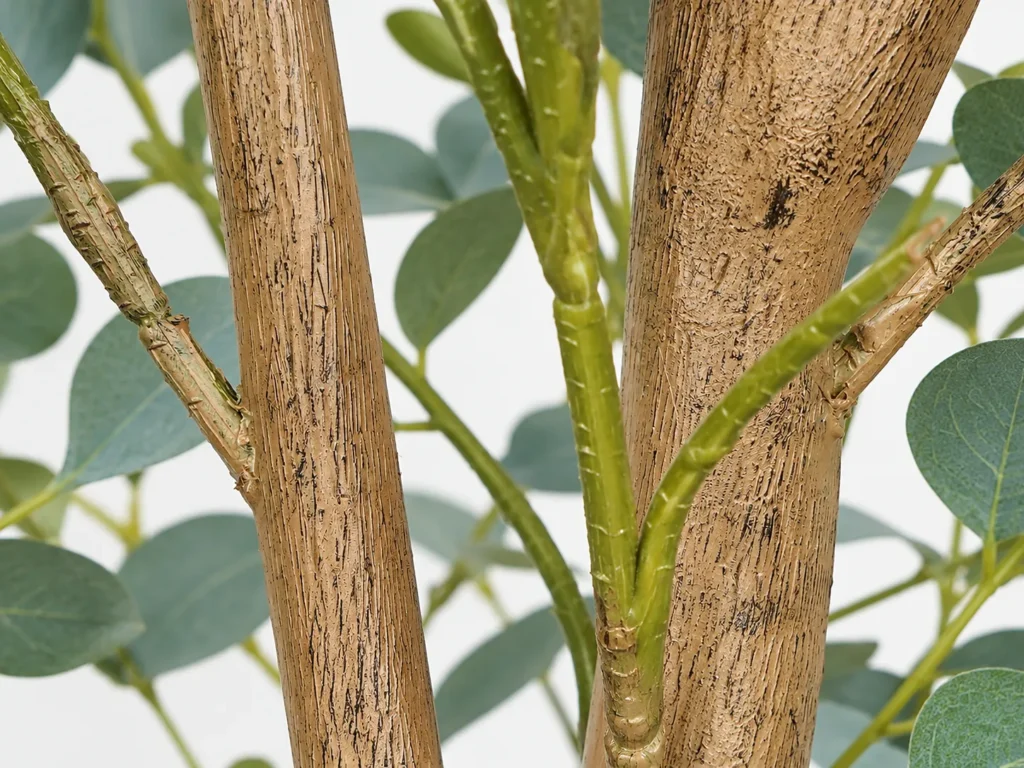
Our recommendation: Examine three areas before making a decision.
The leaves
Look at their shape, color variation, and finish. Leaves that suit the species are generally more convincing than foliage that simply looks bright or abundant.
The trunk
Look for natural variation in texture and color. A completely uniform trunk may feel less organic, especially on trees designed to imitate mature woody plants.
The branch connections
Pay attention to where larger branches meet smaller stems. Abrupt transitions or highly visible attachment points may affect the appearance, particularly in an airy tree with an exposed branching structure.
If close-up images aren’t available, customer photos may help.
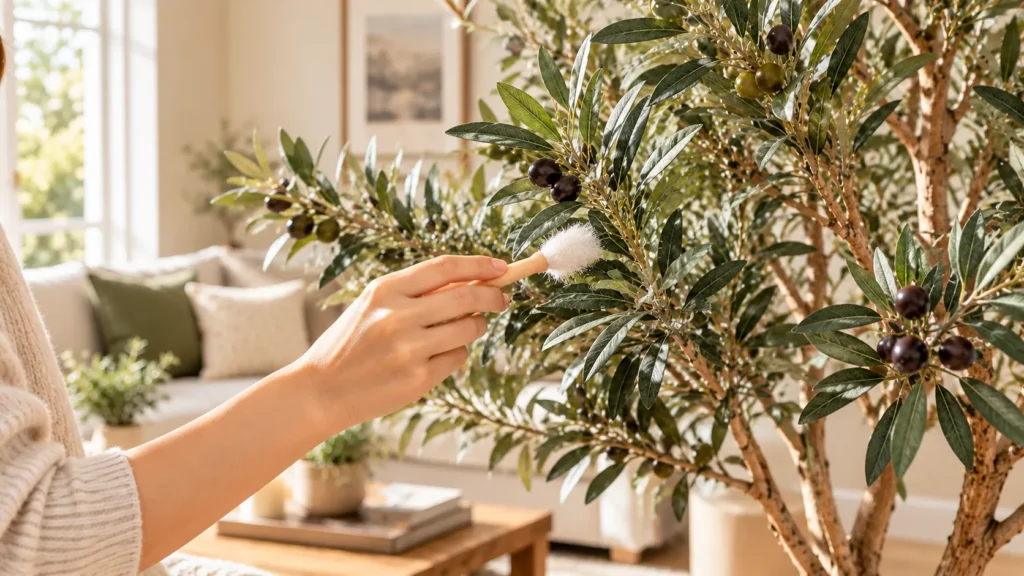
The takeaway: If realistic appearance matters to you, prioritize believable construction over foliage quantity alone.
Want to understand what makes artificial foliage look more natural? Explore our How to Make an Artificial Tree Look More Realistic guide for a closer look at branch shaping, visual balance, and finishing details.
6. Read Customer Reviews Like a Smart Shopper
A five-star average can be reassuring, but it doesn’t tell you whether a particular tree will suit your expectations.
Instead of reading only the most positive or negative reviews, look for patterns.
Start with reviews that mention the exact size and style you’re considering.
Then pay attention to four things:
Appearance: Do multiple buyers say the tree looks like the product photos?
Dimensions: Are there repeated comments about unexpected height or width?
Assembly: Do buyers describe the process as straightforward, confusing, or time-consuming?
Condition on arrival: Are there recurring mentions of damaged leaves, loose decorative fruit, or problems with the base?
Customer photographs are particularly useful because they show how the tree looks in ordinary homes, with everyday lighting and furniture.
But remember that one person’s idea of a perfectly full tree may be another person’s idea of an unnaturally dense canopy.
Our recommendation: Give more weight to repeated, specific observations than to a single enthusiastic or disappointed review.
For additional guidance, the Federal Trade Commission’s guide to evaluating online reviews explains why it’s important to consider review sources, potential incentives, and patterns across different opinions.
7. Know What’s Included—and Where the Tree Can Be Used
Before clicking Buy, take one final look at the product details.
A decorative planter shown in a lifestyle image may not be included. Some trees arrive with a compact original base intended to fit inside a larger decorative container.
Confirm:
- What’s included in the package
- The original planter’s dimensions
- Whether assembly is required
- The intended placement environment
- The seller’s return policy
One detail worth taking seriously: Indoor versus outdoor use.
Not every artificial tree is made with UV-resistant or weather-resistant materials.
An artificial tree designed primarily for indoor décor may fade or deteriorate if left outdoors for extended periods.
Adorbox’s current artificial tree collection is primarily intended for indoor decorative use and is not specifically rated for prolonged UV exposure or year-round outdoor conditions.
Our recommendation: Never assume an artificial tree is suitable for long-term outdoor use unless the product specifications explicitly confirm it.
A covered porch can still expose a tree to sunlight, moisture, wind, and changing temperatures.
Before ordering, review the seller’s delivery, return, and refund policies. The FTC’s online shopping advice also recommends checking these details before making a purchase.
A Quick Buying Checklist
Before choosing your artificial tree, make sure you can answer these questions:
- Does the tree’s silhouette suit my room?
- Have I checked both height and canopy width?
- Have I seen more than one product angle?
- Do the leaves, trunk, and branch connections look convincing?
- Have I watched an assembly video, if available?
- Have I checked customer photos and reviews for the correct model?
- Do I know which planter and components are included?
- Is the tree suitable for the location where I plan to use it?
If several important details are missing, it’s worth asking the seller before ordering.
Frequently Asked Questions
Is a more expensive artificial tree always more realistic?
Not necessarily. Price alone doesn’t guarantee realistic foliage, convincing branch construction, or accurate proportions. Compare actual product details and customer photos rather than relying only on price.
Should an artificial olive tree look full or airy?
Olive trees naturally have irregular branching patterns and can have an open, airy appearance. Look for a balanced silhouette and believable foliage distribution rather than maximum density.
How can I tell whether an artificial tree will fit my room?
Check the overall height, canopy width, and base dimensions. Measure the intended space, including nearby furniture and walkways, before ordering.
Are artificial trees difficult to assemble?
It depends on the model. Some require connecting sections, while others mainly need branch shaping. A product-specific assembly video is one of the clearest ways to understand what’s involved.
Can shaping fix a sparse-looking artificial tree?
Shaping can redistribute existing branches and improve the silhouette, but it cannot add foliage or repair damaged components.
Can I leave an artificial tree outside all year?
Only if the product is specifically designed and rated for the relevant outdoor conditions. Indoor decorative trees may deteriorate with prolonged sunlight and weather exposure.
Choose the Tree That Fits Your Home—not Just the Photo
The best artificial tree isn’t necessarily the tallest, fullest, or most expensive.
It’s the one that looks right in your space, has the details you care about, and meets your expectations when it arrives.
Start with the silhouette. Check the actual dimensions. Look beyond the main product image. And whenever possible, watch the tree being assembled before making your decision.
A little research now can make choosing the right tree much easier.
Explore Adorbox Artificial Trees →
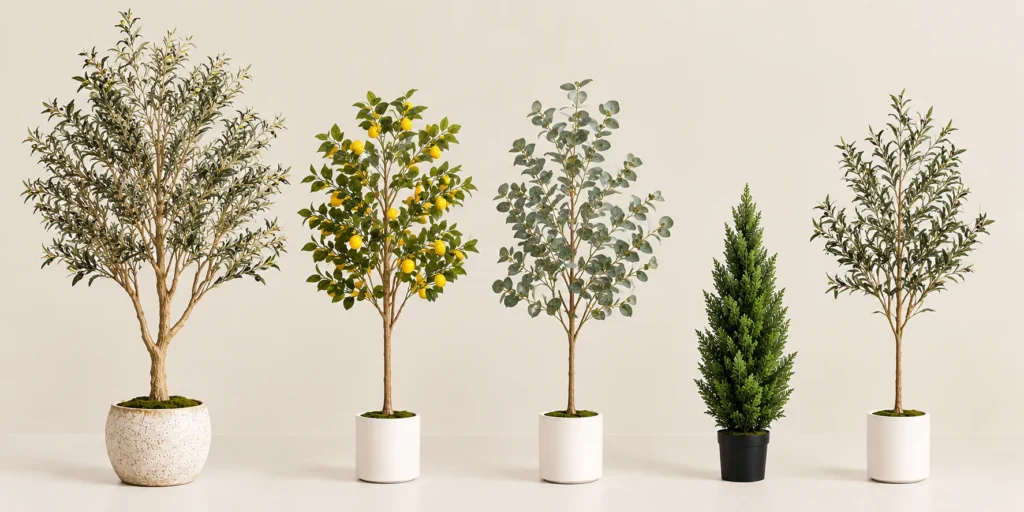
Discover artificial olive, eucalyptus, lemon, and cedar trees for different interior styles and spaces.