An artificial tree can make an empty corner feel intentional, soften the lines of a sofa, or bring a natural focal point into a dining room. But even a beautiful tree can look out of place when its size, shape, or position doesn’t work with the room.
The secret isn’t simply finding an empty spot. It’s understanding how the tree relates to your furniture, how much usable space it occupies, and what you see when you enter or sit in the room.
Whether you’re styling an artificial olive tree, lemon tree, eucalyptus tree, or cedar tree, this guide will help you make better placement decisions—with practical measurements, interior design principles, real-room examples, and common mistakes to avoid.
1. Find the Right Spot Before You Move the Tree
Before choosing a corner, ask yourself what you want the tree to do.
Does your living room need more height beside a low sofa? Is a bare wall making the dining area feel unfinished? Or are you trying to bring greenery into a small room without sacrificing valuable floor space?
Different problems call for different placements.
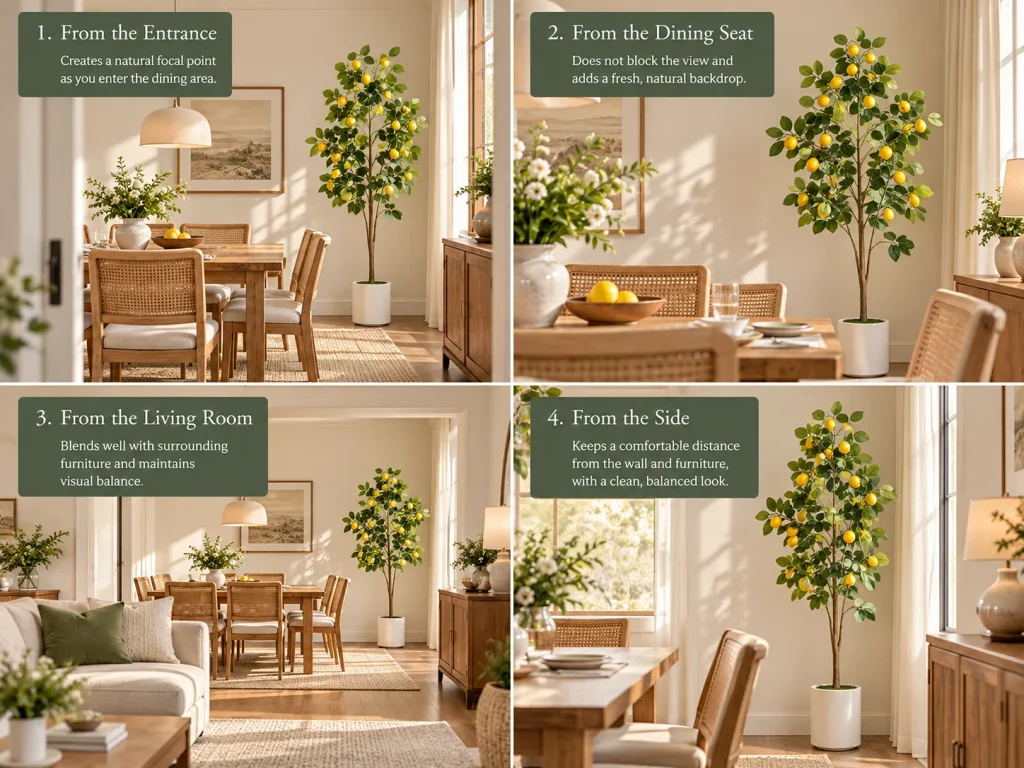
Look at the Room from Its Main Viewing Points
Start by standing in the doorway. Notice where your eyes naturally go and which areas feel visually empty.
Then sit where you normally spend time—on the sofa, at the dining table, or at your desk.
A tree that looks perfectly placed from the entrance might block a window, overlap a floor lamp, or disappear behind a chair from another angle.
Try this: Before settling on a position, check the proposed location from at least two places you regularly use. You want the tree to contribute to the room from everyday viewing angles, not just in a photograph.
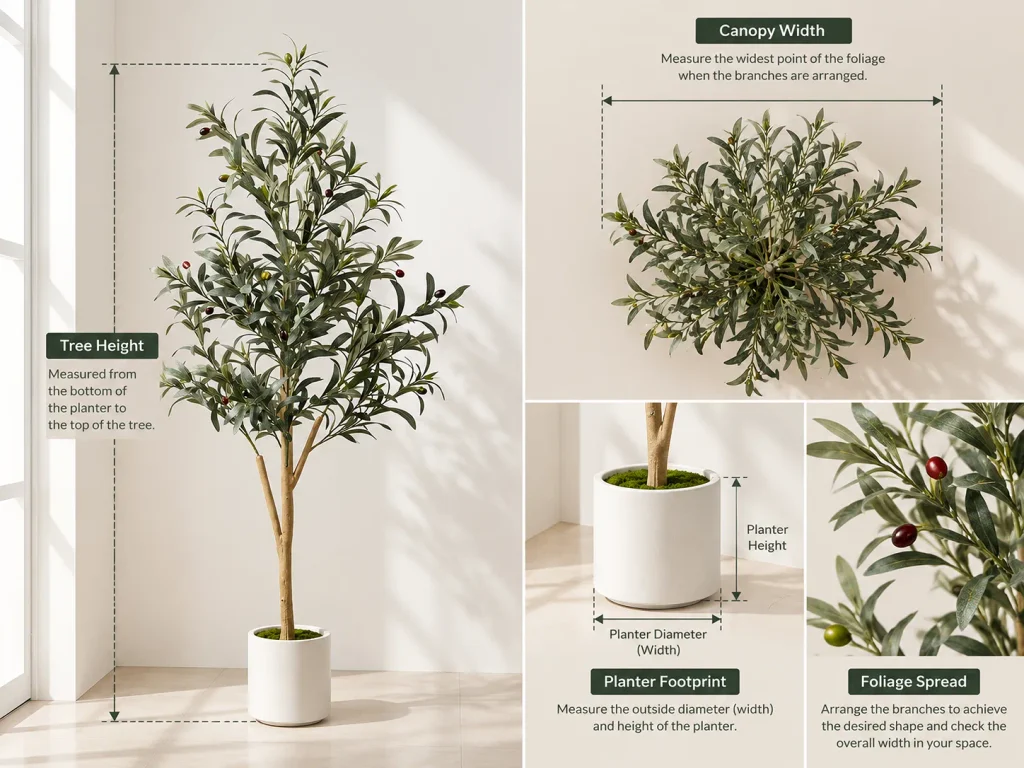
Measure More Than the Tree’s Height
A 6 ft tree isn’t automatically suitable for every room with an 8 ft ceiling.
You also need to consider:
- Overall height: Will the top of the tree have comfortable clearance beneath the ceiling or any overhead fixture?
- Canopy width: How much horizontal space will the branches occupy when arranged?
- Planter footprint: Does the base fit without obstructing furniture or movement?
- Nearby furniture: Will the branches interfere with a lamp, curtain, cabinet, or doorway?
For example, Adorbox offers single-trunk artificial olive trees in 5 ft and 6 ft heights, as well as three-trunk versions in 6 ft, 7 ft, and 8 ft.
The height helps narrow your choices, but it doesn’t tell you everything about how the tree will fit. Always check the actual product dimensions before making a final decision.If you’re comparing different tree heights, explore our Shop by Height guide to narrow down the options for your space.
Test the Position Before Committing
If you already own the tree, place it in the proposed location before adding decorative accessories.
If you’re shopping, use painter’s tape to mark the intended planter position on the floor. You can also mark the approximate canopy width using the product’s actual dimensions.
Walk through the room, open nearby doors, and move any chairs or drawers that normally use the space.
If the location only works when nobody is moving, it probably isn’t the best location.
2. Three Interior Design Principles That Make Artificial Trees Look Better
A well-placed artificial tree should feel connected to the room rather than added as an afterthought.
Three established design principles can help: visual balance, negative space, and layering.
Balance the Tree with the Furniture
Visual balance is about how different elements distribute attention across a room.
A large sectional sofa has substantial visual weight because of its size and shape. A taller tree with a fuller canopy may help balance the composition at one end, while a smaller tree might become less noticeable.
But height alone doesn’t determine visual weight. Dense foliage, a wide canopy, and a prominent planter can make a tree appear heavier than a taller tree with an open branching structure.
Practical example: If one side of your living room contains a large sofa and the opposite corner feels bare, consider whether an artificial tree could introduce height and greenery on the quieter side.
An Adorbox three-trunk olive tree may be worth considering in a spacious room, provided its actual dimensions fit. In a more compact layout, a 5 ft or 6 ft single-trunk olive tree may offer a better balance.
When this doesn’t work: Don’t add a large tree simply to make both sides of the room equally full. If the tree blocks a walkway or crowds other furniture, a smaller accent—or no tree at all—may be the better design decision.
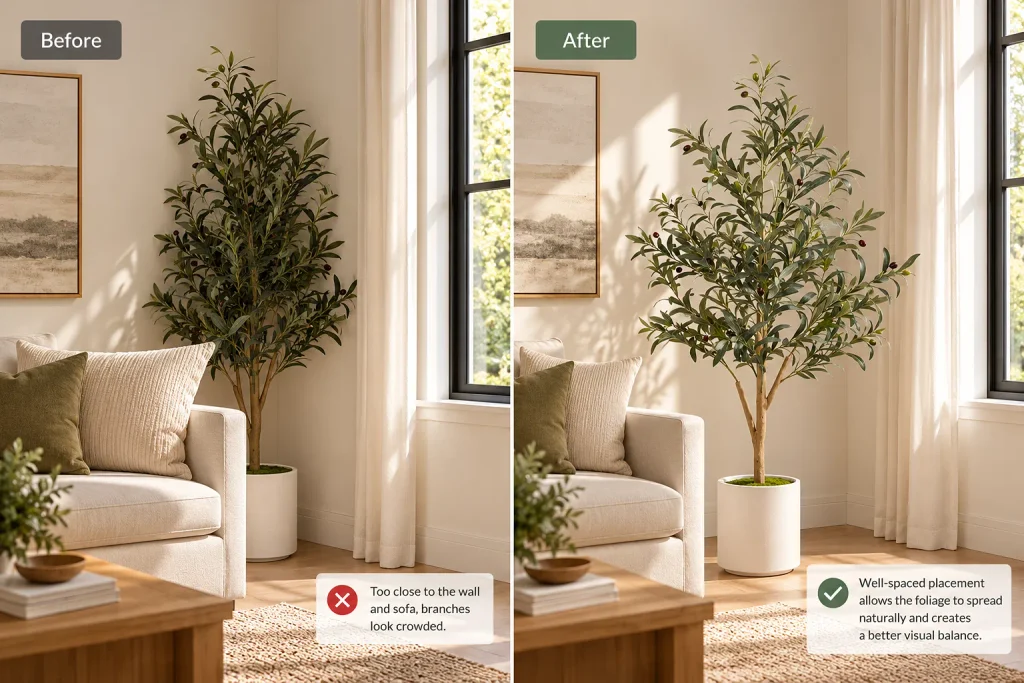
Leave Enough Negative Space Around the Canopy
Negative space is the open area around furniture and decorative objects. It helps individual elements remain visually distinct.
When an artificial tree is pushed tightly between a sofa, wall, and floor lamp, its foliage can become part of a cluttered mass rather than a recognizable shape.
Try moving the tree slightly forward or sideways, where space permits, so more of its branching silhouette remains visible.
You don’t need to maintain a fixed number of inches between every branch and the wall. The useful test is whether the canopy can be arranged naturally without interfering with surrounding objects.
Styling tip: Take a photo from the room’s main entrance. If the tree looks visually tangled with several nearby objects, try simplifying the area or adjusting its position.
Create Height and Depth with Layering
Rooms often look more interesting when objects sit at different heights and depths.
Think of a sofa, a side table, and an artificial tree. Each occupies a different vertical level, creating a more varied composition than three objects of similar height.
You can also position the tree slightly behind the visual line of a side table, provided the planter and branches remain clear of the furniture.
This works especially well beside reading chairs, sofas, and low storage cabinets.
When to avoid it: If the space is narrow, don’t force multiple decorative layers into the same corner. One well-positioned tree can be more effective than a crowded arrangement.
3. How to Fit an Artificial Tree Without Wasting Floor Space
An artificial tree uses floor space just like any other furnishing. The most efficient placement is one that adds visual value without taking away space needed for everyday activities.
Protect Your Main Walkways First
A common residential layout reference is approximately 36 inches of clear width for a main walking route. Shorter secondary routes are sometimes planned around 30 inches, depending on how they’re used.
These are general planning references, not universal building-code requirements. Homes with accessibility needs or specific local requirements may need different clearances.
For artificial trees, measure the remaining clear route after accounting for the planter and any branches extending into the walking area.
Example:
Imagine a passage that is 48 inches wide. A proposed planter arrangement extends 18 inches into that passage.
48 − 18 = 30 inches of remaining clear width.
That may leave less space than you’d want for a frequently used main route. Instead of placing the tree there, look for a wider section or a corner outside the traffic path.
The lesson is simple: measure the space that’s left, not just the space the tree occupies.
Use Corners That Don’t Serve Another Purpose
Not every empty corner is wasted space.
Some corners are needed for opening doors, pulling out dining chairs, accessing storage, or moving comfortably around furniture.
A genuinely useful tree location is one where the space isn’t already performing an important function.
For example, the outer end of a sofa may offer a better position than the narrow passage behind it. Similarly, a corner beside a dining room sideboard may work better than the area directly behind a dining chair.
Before adding a tree, check what happens when the room is being used—not just when everything is neatly pushed into place.
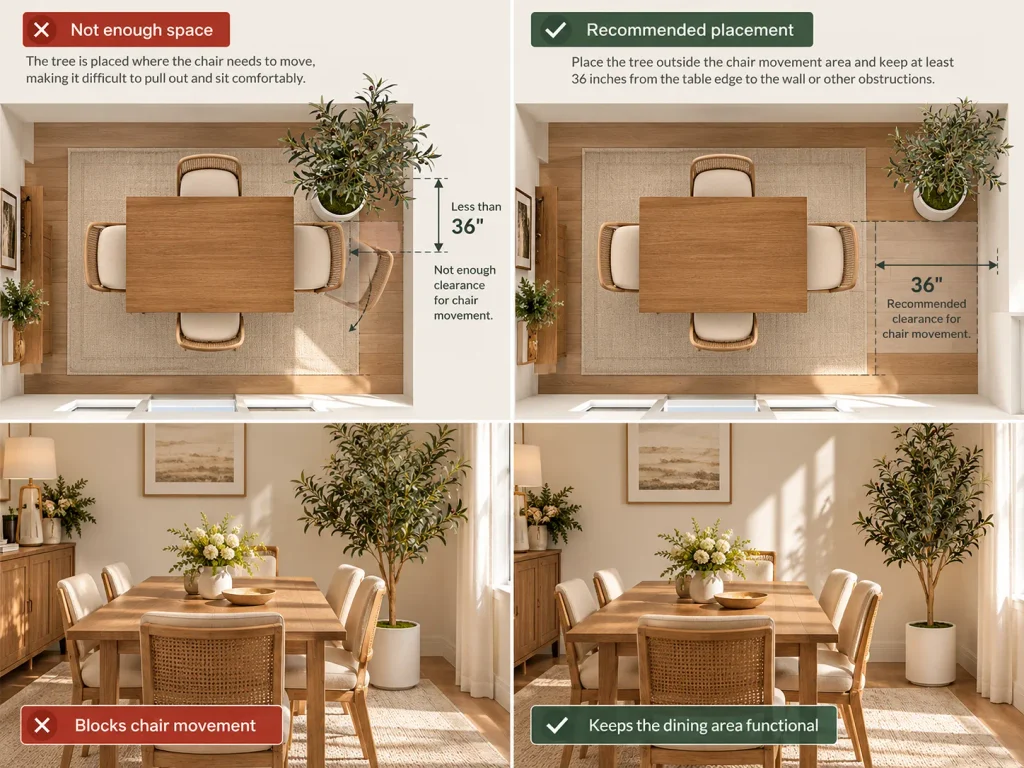
Account for Dining Chair Movement
Dining rooms deserve particular attention because chairs move.
A frequently used planning reference is approximately 36 inches from the table edge to a wall or obstruction to allow chairs to be pulled out and occupied. More room may be needed where people must walk behind seated diners.
Consider a dining room with 60 inches between the table edge and the wall.
If you’re reserving 36 inches for chair use, only 24 inches remain beyond that activity zone.
That doesn’t automatically mean a tree with a 24-inch planter will fit. You must also consider the tree’s canopy, the chair’s actual movement, and whether anyone needs to pass behind it.
A 5 ft Adorbox artificial lemon tree could be considered for a dining corner, but only after checking those dimensions.
Better approach: Place the tree beside the dining arrangement, outside the chair movement area, rather than squeezing it directly behind a frequently used seat.
Make Use of Vertical Space Without Crowding It
Artificial trees are useful for introducing height where floor space is limited, but a tall tree isn’t necessarily a space-saving tree.
A narrow silhouette may use less horizontal space than a broad canopy of the same height.
If you’re decorating a compact entryway or hallway, evaluate the tree’s actual width and planter footprint before focusing on its height.
Adorbox’s 4 ft artificial cedar trees offer a different styling option from taller olive trees, particularly for coordinated entry displays. However, paired placement only makes sense when both sides of the entrance have sufficient clearance.
4. Match Your Artificial Tree to Your Interior Style
The most effective tree choice depends on more than the room name.
Look at the shapes, colors, and materials already present in your home. Then choose a tree whose foliage and overall silhouette complement those elements.
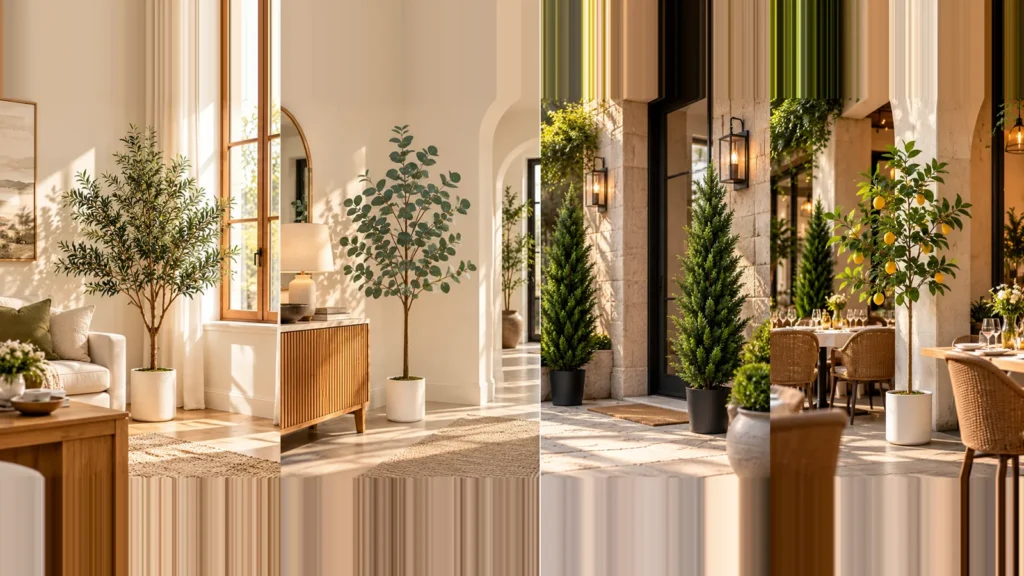
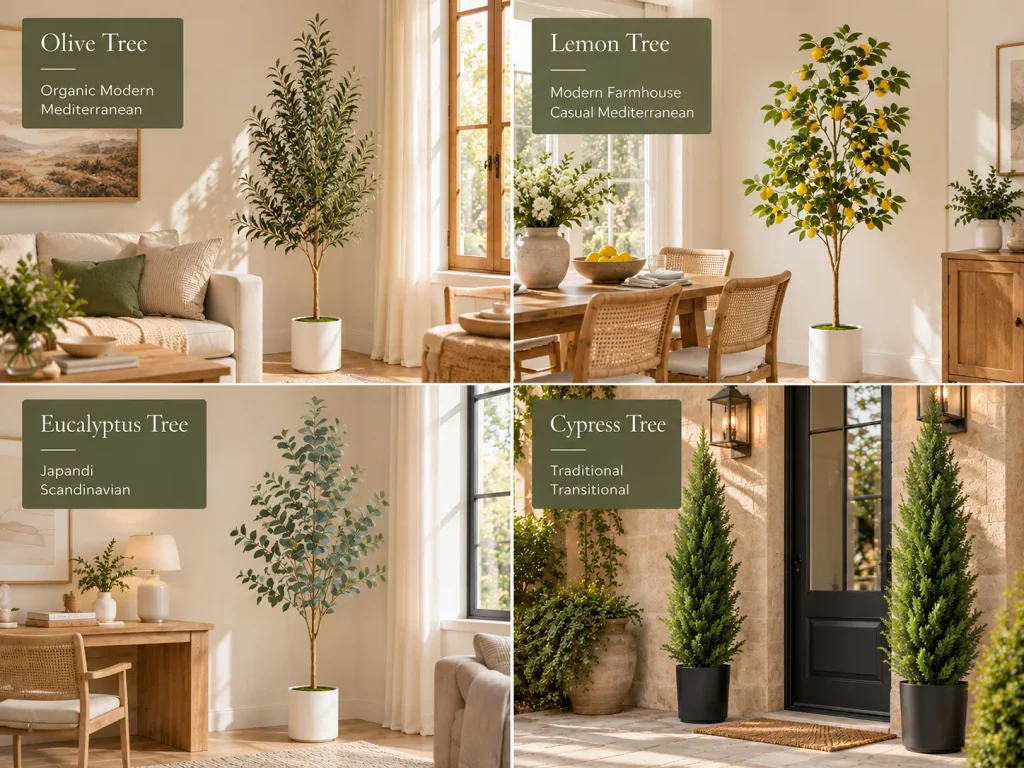
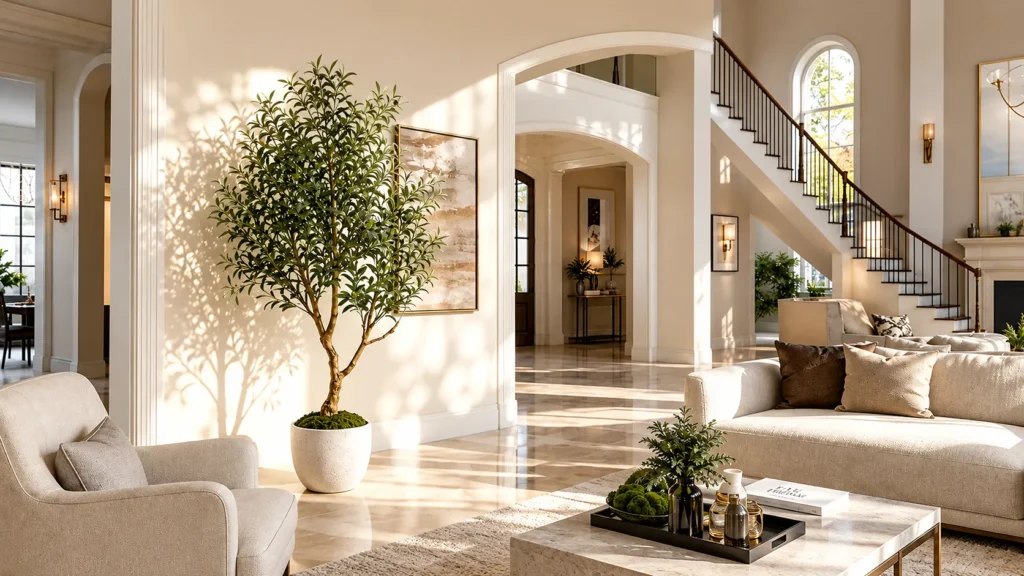
Modern Mediterranean and Organic Modern: Artificial Olive Trees
Modern Mediterranean interiors often combine warm white walls, natural wood, stone, linen, and restrained earthy colors.
An artificial olive tree works well with this palette because its narrow leaves and branching structure introduce organic detail without requiring brightly colored foliage.
For a relaxed living room, consider a 5 ft or 6 ft Adorbox single-trunk olive tree beside a neutral sofa or reading chair.
In a larger room, a 7 ft or 8 ft three-trunk olive tree can create a stronger focal point when there’s adequate room for its canopy.
Styling advice: Let the tree contrast gently with the furniture. Against a cream wall, the foliage becomes visible without introducing another dominant color.
Avoid: Crowding the tree with several additional planters, woven baskets, and decorative objects simply to create a Mediterranean look. A restrained arrangement often allows the olive tree’s form to stand out more clearly.
Japandi and Scandinavian: Artificial Eucalyptus Trees
Japandi and Scandinavian-inspired spaces often emphasize clean lines, natural materials, soft neutrals, and uncluttered surfaces.
Adorbox’s artificial eucalyptus trees, available in 5 ft and 6 ft heights, can complement these settings through their rounded foliage and gentle organic shape.
Try positioning one beside a light oak bookshelf, a simple upholstered chair, or an uncluttered home-office desk.
Styling advice: Use the tree as a counterpoint to straight furniture lines. Allow enough open wall or floor area around it so the foliage doesn’t visually merge with nearby objects.
Avoid: Adding a large collection of mismatched decorative accessories around the planter. In a minimalist room, the tree itself can provide the natural texture the space needs.
Modern Farmhouse and Casual Mediterranean: Artificial Lemon Trees
Artificial lemon trees bring a different kind of visual character.
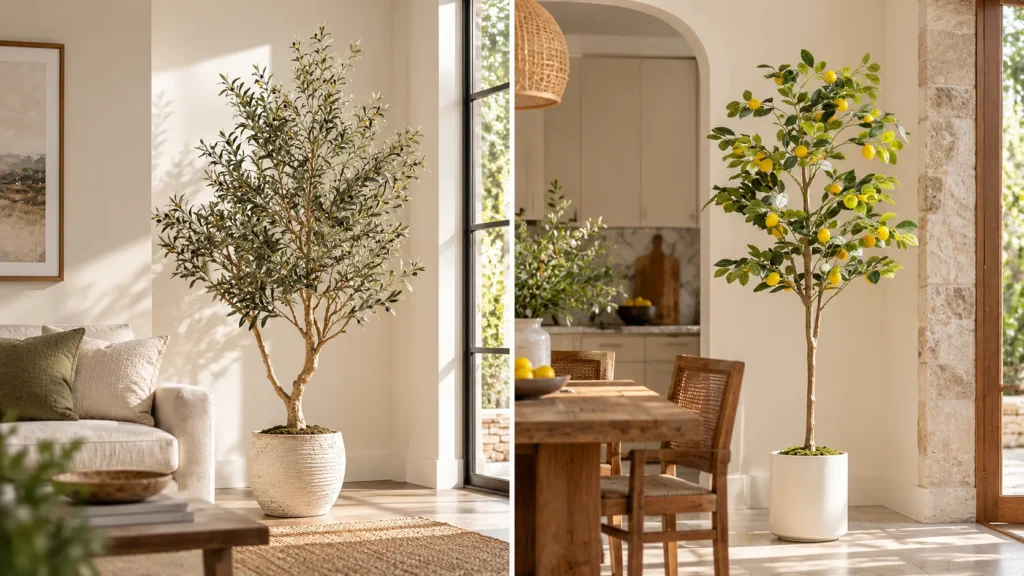
Their yellow fruit introduces a stronger color accent than foliage-only trees, making them appealing in breakfast nooks, dining rooms, and relaxed interiors with warm wood and light-colored furnishings.
Adorbox’s 5 ft and 6 ft artificial lemon trees offer two height options for these settings.
A 5 ft tree may be worth considering for a smaller dining corner, while a 6 ft version can create more vertical presence where the room allows.
Styling advice: Repeat the tree’s natural tones subtly through existing wood, cream, or muted green elements. You don’t need to add matching yellow accessories throughout the room.
Avoid: Placing the lemon tree in an already busy corner filled with colorful artwork, patterned curtains, and several competing decorative pieces. The fruit is already a noticeable accent.
Traditional and Transitional: Artificial Cedar Trees
Traditional and transitional interiors often feature more structured furniture arrangements, defined entryways, and architectural symmetry.
Adorbox’s 4 ft artificial cedar trees, available in 2-pack and 4-pack configurations, can work as coordinated decorative accents in these environments.
A pair positioned on either side of an appropriately sized entrance can create a balanced composition.
Styling advice: Check both sides of the doorway before using a symmetrical arrangement. Matching trees work best when they don’t obstruct door movement or reduce necessary walking space.
Avoid: Forcing symmetry into a narrow or uneven entryway. If one side is occupied by a closet door or furniture, a single well-placed tree or another arrangement may be more practical.
These style pairings are suggestions, not strict rules. An olive tree can work in a contemporary office, and a eucalyptus tree can look beautiful in a traditional home. The room’s actual proportions and furnishings matter more than its style label.
5. Five Practical Artificial Tree Placement Ideas for Real Homes
Now let’s apply these principles to common spaces.
Idea 1: Beside the Sofa in a Living Room
Best for: Adding height and softening a large piece of furniture.
Try placing an artificial olive tree near the outer end of the sofa, where its trunk remains visible and its canopy doesn’t interfere with a lamp or side table.
A 6 ft single-trunk olive tree is one option to evaluate. In a spacious living room, a three-trunk olive tree may offer a stronger presence.
Check the view from the entrance and from the main seating position.
Don’t use this placement if: The tree would narrow the main route around the sofa or prevent a nearby cabinet from opening.
Idea 2: Near a Window Without Blocking the View
Best for: Creating a natural-looking backdrop with daylight.
Place the tree to one side of a window rather than automatically centering it in front of the glass.
Soft daylight can create attractive highlights and shadows across artificial foliage, but artificial trees don’t require sunlight to survive.
An olive or eucalyptus tree can work here, depending on the room’s style and available space.
Don’t use this placement if: The tree blocks a frequently opened window, interferes with curtains, or would be exposed to unsuitable heat or prolonged intense direct sunlight.
Idea 3: In a Dining Room Corner
Best for: Adding vertical interest without placing more objects on the dining table.
A 5 ft or 6 ft Adorbox artificial lemon tree can provide a colorful focal point in a dining room with neutral furniture.
Choose a corner outside the normal chair movement area.
Don’t use this placement if: Someone needs to move the tree every time they pull out a chair.
Idea 4: Beside a Bedroom Chair or Home-Office Bookshelf
Best for: Softening furniture lines without creating visual clutter.
A 5 ft artificial eucalyptus tree can work beside a reading chair, dresser, or bookshelf where there is enough clear floor space.
Keep the surrounding accessories simple and make sure drawers, wardrobe doors, and office chairs remain usable.
Don’t use this placement if: The branches obstruct the desk, the planter occupies necessary chair space, or the tree makes a small room feel crowded.
Idea 5: At the Edge of an Open-Plan Living Area
Best for: Creating a visual transition between living and dining spaces.
A larger artificial olive tree can help indicate where one furniture grouping ends and another begins.
For a generous open-plan interior, a 7 ft or 8 ft Adorbox three-trunk olive tree may be worth evaluating.
Position it near the edge of the seating arrangement rather than in the middle of the route between the sofa and dining table.
Don’t use this placement if: The canopy interrupts important sightlines or the planter creates a bottleneck between the two areas.
6. Artificial Tree Placement Mistakes to Avoid
Sometimes the easiest way to improve a room is to correct a placement that almost works.
Here are five common mistakes and what to do instead.
Mistake #1: Buying the Tallest Tree That Fits Under the Ceiling
Why it goes wrong: Ceiling clearance doesn’t account for canopy width, nearby furniture, or the tree’s visual weight.
An 8 ft tree beneath a sufficiently high ceiling may still feel oversized in a narrow corner.
Better approach: Measure the usable width and depth as well as the height. Compare the tree’s actual product dimensions with the available space before deciding.
For a smaller area, a 5 ft or 6 ft single-trunk olive tree may be worth evaluating before a larger three-trunk version.
Mistake #2: Pushing Every Branch Against the Wall
Why it goes wrong: The canopy can lose depth when branches are compressed into a corner, making the tree look flatter than intended.
Better approach: If space allows, move the planter slightly forward or adjust its position so the foliage can be arranged without pressing against the wall.
You don’t need to leave a fixed gap everywhere. The goal is to preserve the tree’s natural silhouette while keeping the surrounding space functional.
Mistake #3: Placing a Tree Where Furniture Needs to Move
Why it goes wrong: The arrangement may look attractive when the room is empty but become inconvenient during everyday use.
Common problem areas include behind dining chairs, beside wardrobe doors, and near the path of a reclining chair.
Better approach: Test furniture movement before choosing the final location. Open doors and drawers fully and pull chairs out as they would be used.
If the tree interferes, move it outside that activity area.
Mistake #4: Filling a Corner with Too Many Decorative Objects
Why it goes wrong: Multiple plants, baskets, lamps, and accessories can compete for attention, making the arrangement feel crowded.
Better approach: Decide which object should be the main feature.
If the artificial tree is the focal point, try removing unnecessary accessories and checking whether the composition looks clearer.
A single well-placed tree can be enough to finish a corner.
Mistake #5: Choosing a Tree Without Considering the Room’s Style
Why it goes wrong: The tree’s foliage, color, or overall shape may compete with the surrounding furnishings.
For example, a lemon tree with bright yellow fruit may attract more attention than intended in a room already filled with strong colors and patterns.
Better approach: Compare the tree’s visual character with the room’s existing materials, shapes, and color palette.
Choose the tree for the role you want it to play—not simply because it looks attractive in a product photograph.
7. A Practical Checklist Before You Settle on the Final Spot
Before deciding that you’ve found the perfect location, run through these questions:
- Does the tree fit? Check its height, fully arranged canopy width, and planter footprint against the available space.
- Can you move comfortably? Walk through the room and check door swings, chairs, drawers, and other moving furniture.
- Does it look balanced? View the tree from the doorway and your usual seating position.
- Can you see its shape? Make sure the canopy isn’t unnecessarily compressed against walls or hidden behind furniture.
- Does it complement the room? Consider the tree’s foliage, silhouette, and color alongside your existing furnishings.
- Is the location suitable? Confirm the planter is stable and the tree is placed in conditions appropriate for the product.
If something feels wrong, try changing the position before assuming you need a different tree.
Even moving the tree to another corner or changing its orientation may improve how it relates to the furniture.
Once you’ve found the right spot, the next step is making the tree itself look as natural as possible. Our guide, How to Make an Artificial Tree Look More Realistic, covers branch shaping, planter styling, and other finishing details.
Final Thoughts: Let the Room Guide Your Placement
The best place for an artificial tree isn’t necessarily the biggest empty corner or the spot with the most sunlight.
It’s a location where the tree adds height, texture, or visual balance without interfering with how the room works.
Start by measuring the available space. Consider the tree’s silhouette alongside your furniture, protect the areas needed for movement, and choose a style that complements your home.
Whether you’re considering an Adorbox artificial olive tree for your living room, a lemon tree for your dining area, a eucalyptus tree for a quiet home office, or cedar trees for a coordinated entry display, the same principle applies: a tree looks its best when its placement feels intentional.
Explore Adorbox’s artificial tree collection to find a size and style that works for your space.
Frequently Asked Questions
Where is the best place to put an artificial tree in a living room?
An empty corner, the outer end of a sofa, or a position beside a window can all work well. The best choice depends on the tree’s dimensions, surrounding furniture, and available walking space. Check the location from more than one viewing angle before deciding.
How much space should I leave around an artificial tree?
There is no universal clearance distance around the foliage. Allow enough space for the canopy to maintain its intended shape without interfering with furniture. For main walking routes, approximately 36 inches of clear width is a common residential planning reference, subject to the home’s actual requirements.
Can I put an artificial tree in a room without natural light?
Yes. Artificial trees don’t need sunlight to grow, making them suitable for many rooms with limited natural light. Consider the room’s existing lighting so the foliage remains visually appealing, and follow any product-specific placement instructions.
What size artificial tree works best with an 8 ft ceiling?
A 5 ft, 6 ft, or potentially 7 ft tree may be suitable, depending on its canopy shape, the room’s proportions, and overhead obstructions. Height alone isn’t enough to determine the best choice. Always check the complete product dimensions and available floor space.
Should an artificial tree match my interior design style?
It doesn’t have to match every decorative detail, but its shape, foliage, and color should work with the room’s overall composition. Olive trees can complement warm, organic interiors, eucalyptus trees can soften minimalist spaces, lemon trees add a colorful accent, and cedar trees can support more structured entryway arrangements.